
4D Thermography. Physics + data, continuously.
4D Thermography creates a 3D photogrammetric view of an asset, continuously over time, from arrays of infrared cameras. It captures how system behaviour evolves — not just where it spikes — so emerging failures are detected early, locally, and reliably.
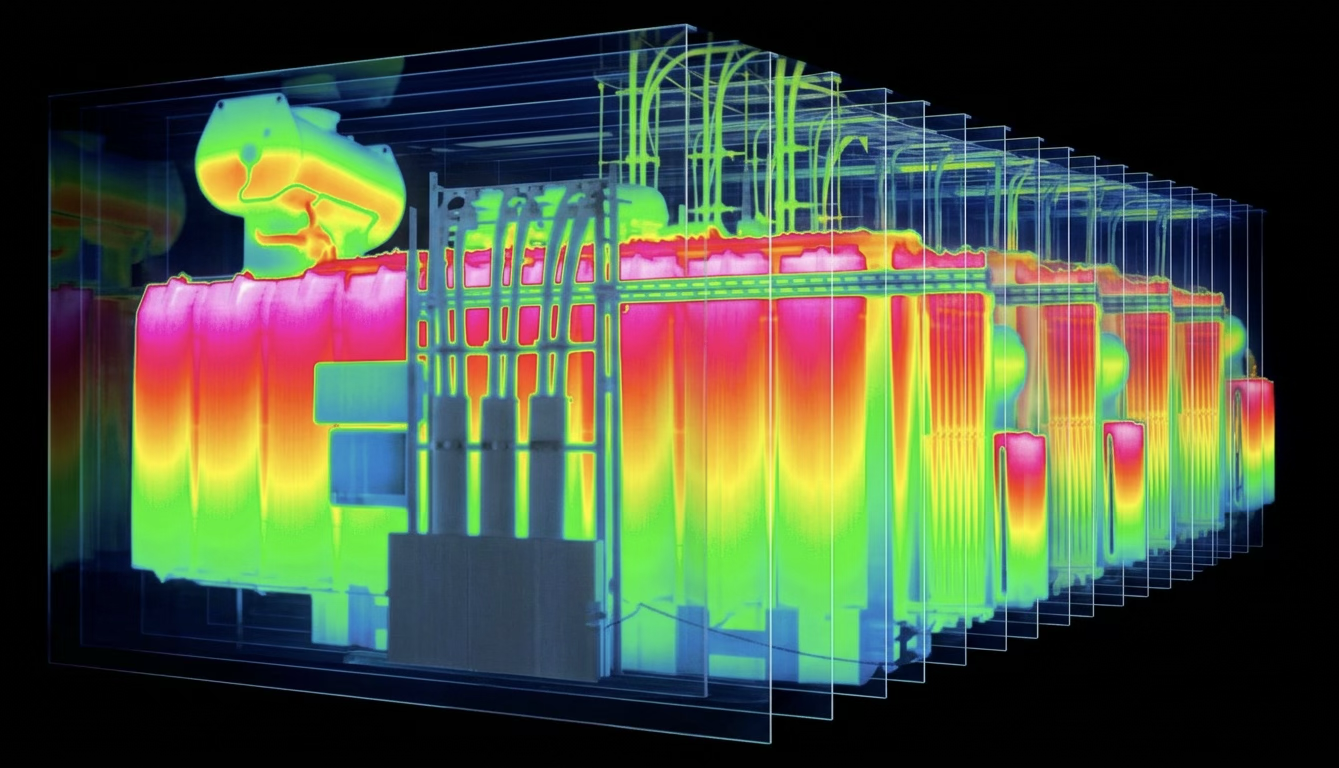
The fourth dimension is time.
Continuous 3D thermal sampling over time creates a proprietary four-dimensional state space for each monitored asset. We characterise its normal thermal cycles — hourly, weekly, seasonal — so anomalies become statistically detectable long before failure.
This is fundamentally different from current/voltage monitoring (a lagging indicator) and from drone or manual IR inspection (isolated 2D snapshots that may not coincide with the moment an anomaly emerges).
Why 4D, why now.
New Optics
Modern materials lower unit cost and unlock new lens geometries for wide-area arrays.
CMOS Silicon
High-volume CMOS fabrication shrinks pixel sizes and slashes cost per sensor.
Edge AI Compute
On-device inference cuts time-to-result and slashes telemetry bandwidth costs.
Compounding Moat
COTS hardware + proprietary algorithms today; custom optics and patentable hardware-algorithm combinations tomorrow.
$50,000 → under $1,000
Infrared sensors that cost $50,000 a decade ago now cost under $1,000 — making massive-scale thermal IoT arrays economically viable for the first time. Halophase is built to ride this curve.
Lagging indicator — only signals trouble after deviation from fixed thresholds.
Isolated 2D snapshots. Almost never coincide with the moment an anomaly emerges.
Continuous 4D state space. Anomalies detectable months before failure.